
Nivalis Nights recipes are discovered through story and business progression, conversations with other restaurant owners, venue popularity rewards, and some relationship outcomes. Discovering a dish is only the first requirement: your venue must also have its listed ingredients, the correct cooking equipment, and an available menu slot before it can serve that dish.
The launch build does not yet have a reliably documented complete recipe catalogue. A pre-release development update mentioned 190 meals, but that number does not establish a verified list of 190 obtainable launch-build recipes. This guide therefore separates confirmed recipe records from promotionally named dishes whose ingredients, equipment, or unlock methods remain unknown.
Confirmed recipe records in the launch build
The following records are supported by launch-build gameplay or a documented quest reward. An unknown field is left unknown rather than reconstructed from the dish name.
| Recipe | Confirmed unlock or availability | Confirmed ingredients | Confirmed equipment | Important limitation |
|---|---|---|---|---|
| Chicken Noodle Soup | Available when setting up the inherited noodle bar during the opening business tutorial | Ramen noodles, chicken, and onions | Food processor and cooker | Serving quantities have not been verified |
| Onion Rings | Discovered from one of the restaurant conversations during the early search for recipe tips | Not verified | Not verified | The exact dialogue path and preparation requirements are not fully documented |
| Beer | Obtained during the early recipe-tip sequence | Wheat is shown as required | Drink machine | The complete recipe record and serving quantities are not verified |
| Brownie | Observed as an unlocked recipe during early noodle-bar play | Not fully verified | Blender | The precise unlock trigger has not been verified |
| Accordion Potatoes | Unlocked when the noodle bar reached popularity tier two in reported launch-build progression | Not verified | Not verified | Venue popularity is distinct from Business Skill, manager level, and permit tier |
| Cheeseburger | Awarded through an affinity-improving conversation with Agent Teleshko during Business Empire progression | Not verified | Not verified | The surrounding quest also concerns a Tier 1 Business Permit, but the permit itself should not be treated as the recipe requirement |
These entries are useful as route markers, not as a fabricated all-recipes database. In particular, a recipe name alone does not justify guessing its components. Even familiar dishes can have setting-specific ingredients or equipment in Nivalis Nights.
The opening recipe route at the noodle bar
The first practical recipe lesson begins after you inherit the noodle bar and start its introductory tasks. Use the venue monitor to inspect the business and add Chicken Noodle Soup to the menu. Its recipe entry identifies ramen noodles, chicken, and onions as the required ingredients, plus a food processor and cooker as the required equipment.
This establishes the basic rule for every later dish: knowing the recipe does not automatically make the dish serviceable. The restaurant still needs the physical inputs and appliances shown in the recipe record.
After the initial setup, Banor explains that a one-dish menu is not enough and sends you to seek recipe tips from nearby restaurant owners. The objective points toward Nola Berg, Dagmar Fitz, and Marius Mitchell. These conversations introduce the social side of recipe discovery. Other businesses regard you as competition, so simply requesting their trade secrets does not always produce a recipe. One conversation in the opening recipe-tip route produces Onion Rings, while another part of the sequence produces Beer.
Dialogue outcomes can differ; do not assume that every response permanently locks or guarantees a specific recipe. Treat the conversations as progression objectives: follow the active markers, pay attention to the relationship response shown during dialogue, and finish the full set before assuming the sequence is stuck.
How to read a recipe before adding it to the menu
The venue monitor brings together the information needed to decide whether a discovered dish is ready for service. Before adding one, inspect four separate checks.
- Confirm that the recipe has actually been discovered. Seeing a food name in promotional material or hearing it mentioned does not put it in your restaurant’s usable collection.
- Read the required ingredient list in the recipe entry. Do not rely on the dish name to predict every component.
- Read the required equipment list separately. Ingredients in storage cannot compensate for a missing cooker, processor, drink machine, blender, or other listed appliance.
- Check the venue’s current menu capacity. Popularity progression can expand the number of available menu items, so a valid recipe may still need to wait until space is available.
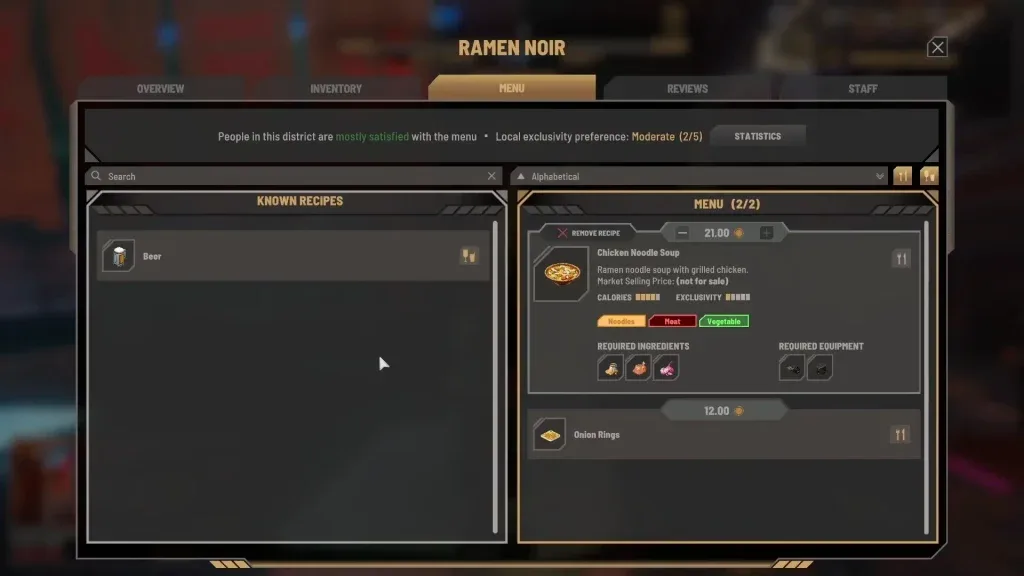
Chicken Noodle Soup demonstrates all four checks clearly. It is known at the opening noodle bar, its three confirmed ingredients are shown, and the food processor and cooker are separate requirements. Beer demonstrates why equipment deserves its own check: having wheat does not replace the need for a drink machine. Brownie requires a blender, which can make it unsuitable for an early menu when the necessary appliance exceeds the available budget.
The venue screen also displays district preferences and pricing controls. Those systems help decide whether a recipe belongs on today’s menu, but they do not change the underlying discovery, ingredient, and equipment requirements. A recipe can be technically available while still being a poor immediate choice for the venue’s budget or customers.
The repeatable recipe workflow
Use a short operational loop whenever you discover a new dish. This prevents an exciting unlock from turning into an unusable menu entry or an expensive shopping mistake.
- Open the recipe record and note only the ingredients and equipment explicitly displayed there.
- Compare those requirements with the venue inventory rather than the player inventory alone. Ingredients need to be transferred into the restaurant’s storage before staff can use them.
- Check whether any ingredient needs refrigerated or frozen storage. The venue inventory explains that some ingredients have storage requirements, and unsuitable stock management can lead to waste.
- Confirm that every required appliance is placed and available at the venue.
- Review the current menu slots and remove an unsuitable offering only if the new dish is ready to replace it.
- Add the recipe through the venue monitor and set its price using the information shown in the business interface.
- Recheck the shopping list and ingredient stocks after service begins. Sales can consume supplies quickly, and vendors may not always carry enough of a needed item.
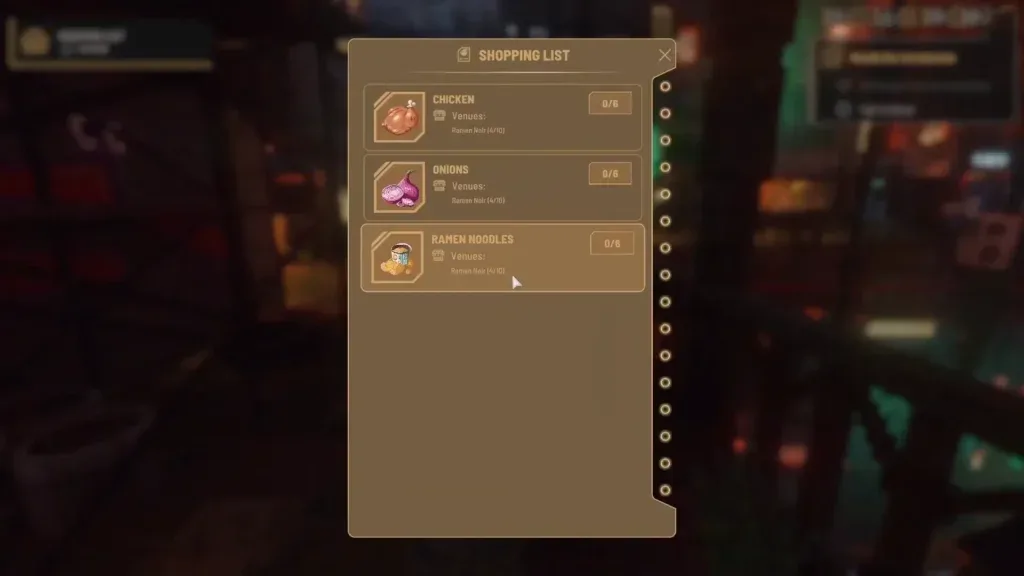
The shopping list is especially useful because it translates the active menu into ingredients you need to obtain. Vendor prices can change with the market, and vendors can also hold limited or decaying stock. Those conditions affect purchasing decisions, but they do not alter the recipe itself. Keep the recipe requirement, the vendor offer, and the condition of the available stock as three separate facts.
Avoid buying large speculative quantities merely because you have unlocked more dishes. Ingredients can spoil, while a larger menu introduces more distinct stock requirements. The supported workflow is to confirm the recipe, choose the menu, and then purchase for that menu. Detailed ingredient sourcing, greenhouse supply, fishing, and manager automation are separate systems rather than recipe unlock methods.
Recipe customization and inspiration
Nivalis Nights also allows recipes to be edited through an inspiration mechanic. During the opening progression, Ava explains that inspiration can be used to edit recipes and create something special for the noodle bar. This is customization of a discovered recipe, not a substitute for discovering the base recipe.
A complete substitution list, an inspiration-earning formula, and the exact sales effect of every edit have not been verified. Use the in-game editing interface as the authority for the save you are playing. If an ingredient cannot be selected there, do not assume that a thematically sensible substitution should work.
A safe customization sequence is:
- Start with a recipe already present in your discovered collection.
- Open its editing controls when the game indicates that inspiration is available.
- Review the ingredients the interface actually permits you to change.
- Save only a variation whose requirements your venue can supply and prepare.
- Recheck the resulting recipe before placing it on the active menu.
This distinction matters when diagnosing a missing option. No inspiration may mean you cannot edit a recipe at that moment, but it does not prove the base recipe is undiscovered. Conversely, having inspiration does not grant an unknown dish automatically.
Progression-based recipe unlocks
Recipe progression is not tied to one universal level track. There are several independent paths, and their labels should not be blended together.
Venue popularity rewards
Accordion Potatoes has been reported as a noodle-bar popularity-tier-two reward. The same milestone expands the venue’s operating limits, including its menu capacity. This is a venue-specific popularity event, not evidence that Business Skill level two or a Tier 2 permit unlocks the same dish.
Continue serving customers and inspect the venue summary when its popularity advances. A new-recipe notification is stronger evidence than assuming every venue tier follows the same reward table.
Quest and relationship rewards
Cheeseburger is a documented dialogue reward during the Business Empire quest. The reward follows a sequence of responses that improves affinity with Agent Teleshko. The broader quest eventually awards a Tier 1 Business Permit, but these are separate outcomes within the same progression sequence.
If your immediate goal is the Cheeseburger recipe, pay attention to the affinity result of the conversation rather than treating ownership of the permit as proof that the recipe must already be present. An alternate recovery method has not been verified if the affinity outcome differs.
Early restaurant conversations
The opening search for recipe tips teaches that other restaurant owners are potential discovery sources. Their willingness to help depends on the conversation, and not every person provides a useful result. Complete the active objective and inspect the recipe-discovered notification instead of assuming that merely meeting an owner adds their food to your collection.
Where to track discovered recipes
The game’s journal-style Entries interface includes a recipe collection alongside other progression records. The collection is organized into food groupings such as meat, fish, and salads, with undiscovered progress extending well beyond the opening dishes.
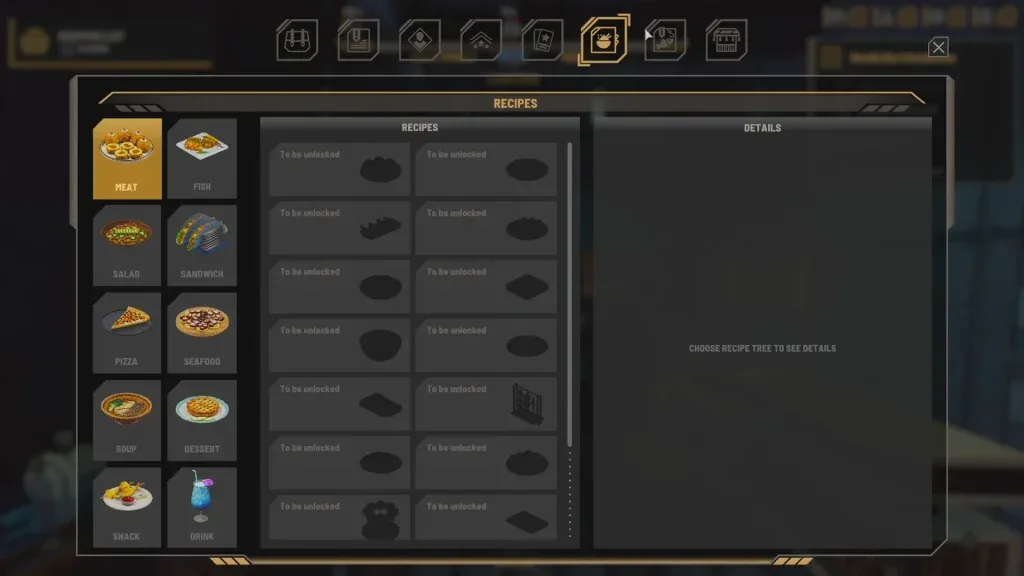
Use this collection to distinguish recipes you have discovered from dishes that are only mentioned elsewhere. Then use the venue monitor for the operational decision: whether a particular restaurant has the ingredients, equipment, and menu room to serve one of those recipes.
That two-screen distinction prevents several common misunderstandings:
- A recipe appearing in the collection does not prove the current venue can prepare it.
- An ingredient appearing in storage does not prove you know a compatible recipe.
- A dish mentioned by an NPC does not prove its recipe has been awarded.
- An available menu slot does not remove ingredient or appliance requirements.
- A recipe unlock notification does not establish its exact quantities unless the recipe screen displays them.
Named dishes without verified launch-build recipes
Official pre-release material named Cola Chicken, Summer Salad, Meridian Pizza, and VegCoffee. These names confirm that the dishes were presented as menu examples, but their launch-build ingredients, equipment, prices, and unlock steps remain unverified.
| Named dish | Supported information | Information still unverified |
|---|---|---|
| Cola Chicken | Named as a dish in official menu material | Ingredients, quantities, equipment, and unlock source |
| Summer Salad | Named as a salad | Ingredients, quantities, and whether availability follows any seasonal rule |
| Meridian Pizza | Named as a pizza | Equipment, ingredients, and unlock requirement |
| VegCoffee | Named as a drink | Recipe components, equipment, sale price, and unlock requirement |
Do not use those four names as a shopping list. They become actionable only after the relevant recipe record appears in the game and exposes its actual requirements.
Checks for a recipe that cannot be served
When a recipe is known but cannot be placed or produced, work through the requirements in order instead of buying random supplies.
- Verify that the recipe is in the discovered collection, not merely in a promotional list or dialogue reference.
- Inspect its required equipment and compare that list with the appliances placed at the venue.
- Check the venue inventory for every listed ingredient and transfer supplies from your personal inventory when necessary.
- Confirm that perishable ingredients have not decayed and that required stock has not already been consumed during service.
- Check the current number of menu items against the venue’s menu capacity.
- If it is a customized version, confirm that the edited recipe was completed and that the venue can meet the variation’s displayed requirements.
- If the unlock should come from a quest, finish the marked conversation or progression step and look for the explicit discovery notification.
A manager, higher Business Skill, or a new business permit should not be treated as a universal remedy. Those systems can affect restaurant operation or wider business progression, but they do not provide a verified way to bypass a recipe’s discovery, equipment, inventory, or menu-slot checks.
The reliable rule for the launch build is simple: trust the discovered recipe record and the current venue interface. Where those screens do not supply a quantity, unlock condition, or preparation requirement, that detail remains unverified.