
The best menu in Nivalis Nights is not a fixed list of named dishes. Use a small, focused selection that matches the venue’s current district preferences, shares ingredients, works with equipment you already own, and can stay stocked without draining the business account. Begin within the venue’s current menu capacity and expand gradually; there is no verified universal dish-count target. A smaller menu is better whenever extra recipes add expensive equipment, isolated ingredients, or unreliable restocking.
Your exact best dishes will change as you discover recipes, upgrade the venue, and move between businesses. The reliable method is to evaluate every candidate against the same checks instead of copying a menu that may not fit your location or current inventory.
The best menu formula
Build the menu in this order:
- Check the local demographic preferences on the venue monitor.
- Select one dependable core dish that matches at least one displayed preference.
- Add dishes that reuse ingredients already required by that core dish.
- Reject any recipe that needs equipment you cannot afford or do not already own.
- Keep at least one lower-risk option whose supplies are easy for you to maintain.
- Add a drink or another category only when it improves the offering without creating a difficult new supply chain.
- Run the menu, then review finances, stock shortages, customer response, and staff performance before expanding it.
This produces a menu tailored to the business rather than a theoretical recipe ranking. A recipe can look attractive in isolation and still be a poor choice if it requires a new appliance, introduces several unique ingredients, or repeatedly becomes unavailable.
Read the venue monitor before choosing dishes
The venue monitor is the main decision screen for menu planning. It shows the restaurant’s menu capacity and gives you access to its finances, inventory, reviews, staff, and local customer information. Do not choose dishes only from the recipe list; compare them inside the business where they will actually be served.
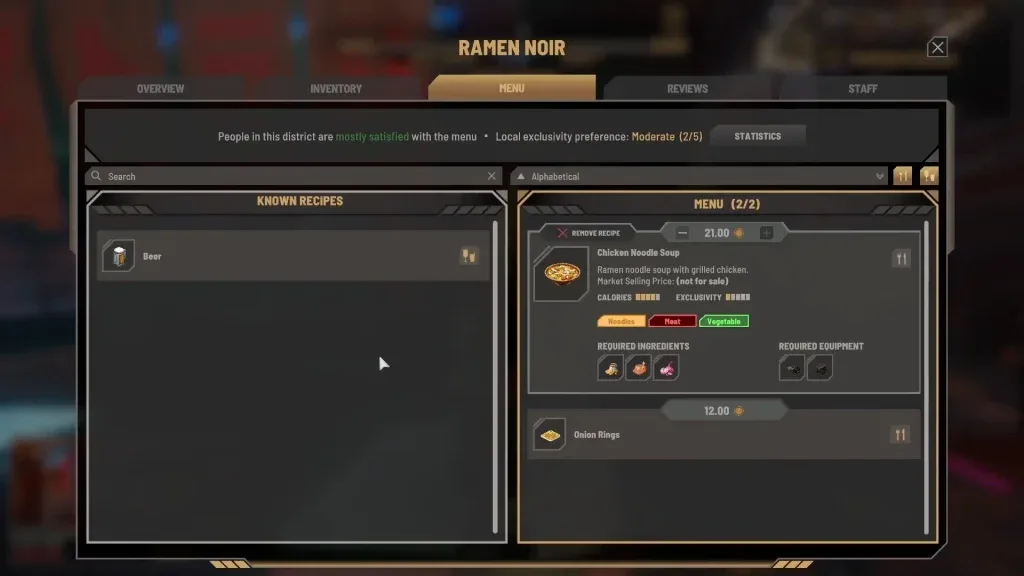
The local demographic panel can show groups such as workers, hipsters, and elites, along with the food traits they currently prefer. Early noodle-bar information, for example, can display preferences for noodles, meat, and mushrooms. Treat the preferences visible in your own venue as the current target because another restaurant or district may call for a different mix.
When judging a recipe, check four things together:
- Preference fit: Does the dish match the food types the district currently wants?
- Ingredient fit: Does it reuse supplies already needed by other menu items?
- Equipment fit: Can the kitchen prepare it with equipment already placed at the venue?
- Operating fit: Can your staff and stock support it consistently through the day?
A dish that scores well on all four checks is usually more useful than a supposedly premium recipe that adds cost and complexity. Customer satisfaction can also respond to pricing, so the best menu is not independent of the prices you set. Avoid treating the highest permitted price as automatically optimal; use the satisfaction display and actual financial results to guide adjustments.
Start with a dependable core dish
At the opening noodle bar, Chicken Noodle Soup provides a clear example of a practical core dish. Its recipe screen identifies ramen, chicken, and onion as required ingredients, while the kitchen needs a food processor and a cooker. The important lesson is not that Chicken Noodle Soup must remain the best dish forever. It is that a core dish should have visible demand, understood requirements, and equipment that the venue can already support.
Once you select a core dish, evaluate every addition relative to it. A second dish that shares chicken or onion can be easier to sustain than one that introduces several unrelated supplies. Shared ingredients reduce the number of separate shortages that can disable part of your menu. They also make manual shopping, greenhouse production, fishing, and inventory checks easier to organize.
Do not assume that more unlocked recipes always improve the restaurant. Recipe discovery gives you options, not obligations. The menu should contain dishes the business can reliably serve, not every dish the player knows.
Use a compact menu instead of every unlocked recipe
A focused menu is especially useful in the launch build because restaurant automation can behave unpredictably. Managers can restock ingredients, but current behavior may include excessive purchases, missed necessities, or purchases of items already held in quantity. A menu with many unrelated ingredients creates more opportunities for the wrong stock to accumulate while an essential item runs out.
A player report described a loss-making noodle restaurant improving after its menu was reduced to roughly four or five dishes and relied more on greenhouse supplies. That result does not establish a hidden menu penalty or prove that five is a magic number. It does demonstrate the practical advantage of reducing the number of ingredients that the restaurant must track.
Use the following size rule:
- Keep the starting menu within the venue’s current capacity; an early venue may allow only two items.
- Expand only when the new dish matches demand and passes the ingredient and equipment checks.
- Pause expansion when one new recipe would require a costly appliance or several unique supplies.
- Cut the weakest dish when repeated shortages, spoilage, or purchasing costs make it unreliable.
- Reassess after venue upgrades unlock more menu space; unlocked capacity is permission to expand, not a requirement to fill every slot.
A compact menu also makes problems easier to diagnose. If the business loses money with four dishes, you can compare their requirements and availability. If it carries a sprawling catalog, the cause may be hidden among overlapping wages, purchases, spoiled inventory, unmet equipment needs, and unavailable items.
Choose dishes by ingredient overlap
Ingredient overlap is the most useful tie-breaker between two otherwise suitable recipes. Start by listing the requirements of your core dish, then favor candidates that reuse one or more of those ingredients. Do not invent quantities or calculate margins from incomplete values; the menu and inventory screens provide the relevant current information for your save.
A simple selection table can keep the decision clear:
| Check | Keep the dish when | Remove or postpone it when |
|---|---|---|
| District demand | Its traits match current local preferences | It adds no useful preference coverage |
| Ingredient overlap | It reuses supplies already kept in stock | Most requirements are unique to that dish |
| Equipment | Required appliances are already available | It demands an unaffordable or missing machine |
| Supply reliability | You can buy, grow, or catch its inputs consistently | A key input is repeatedly unavailable |
| Inventory risk | Stock turns over without creating waste | Ingredients accumulate or spoil before use |
| Menu role | It adds useful variety within capacity | It duplicates another dish without a clear benefit |
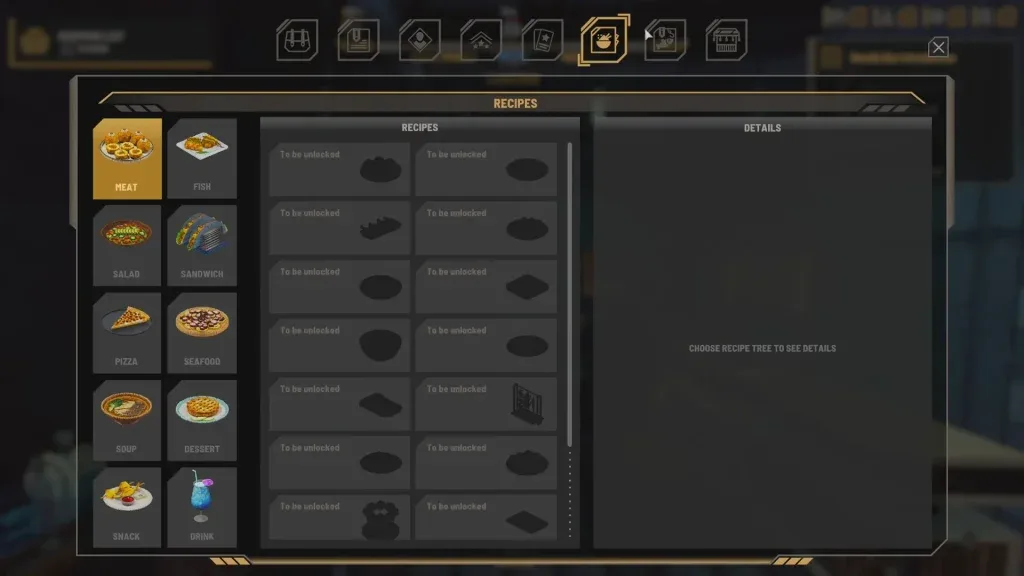
This method does not require a complete recipe database. Apply it to the recipes currently unlocked in your own game. New recipes can come from interactions with other restaurant owners, while inspiration can allow recipe editing. Because unlock progress differs between saves, a universal named menu would ignore the options actually available to the player.
Check equipment before adding a recipe
A recipe is not usable simply because it is unlocked. Its detail screen lists required equipment, and that requirement can turn an appealing dish into a costly mistake. The early Chicken Noodle Soup example needs a food processor and cooker. Another unlocked dessert may require a blender, adding an expense that can be difficult to justify while the restaurant is still establishing itself.
Use this equipment test before confirming any menu change:
- Open the candidate recipe and identify every required appliance.
- Confirm that each appliance is already present and usable at the venue.
- If something is missing, compare its cost with the restaurant’s available cash and recent balance.
- Consider whether the machine will support several planned dishes or only one optional item.
- Postpone the recipe if buying the appliance would leave too little cash for ingredients and wages.
Equipment that supports several strong dishes is easier to justify than a machine purchased for one recipe with weak local demand. Early in the game, using the kitchen you already have is usually safer than chasing menu variety through major purchases.
Restock from the Shopping List without double-counting
After setting the menu, use the Shopping List to see what the venue still lacks. The displayed figures represent the remaining shortage. Do not subtract ingredients already stored at the venue a second time; doing so can leave the restaurant understocked.
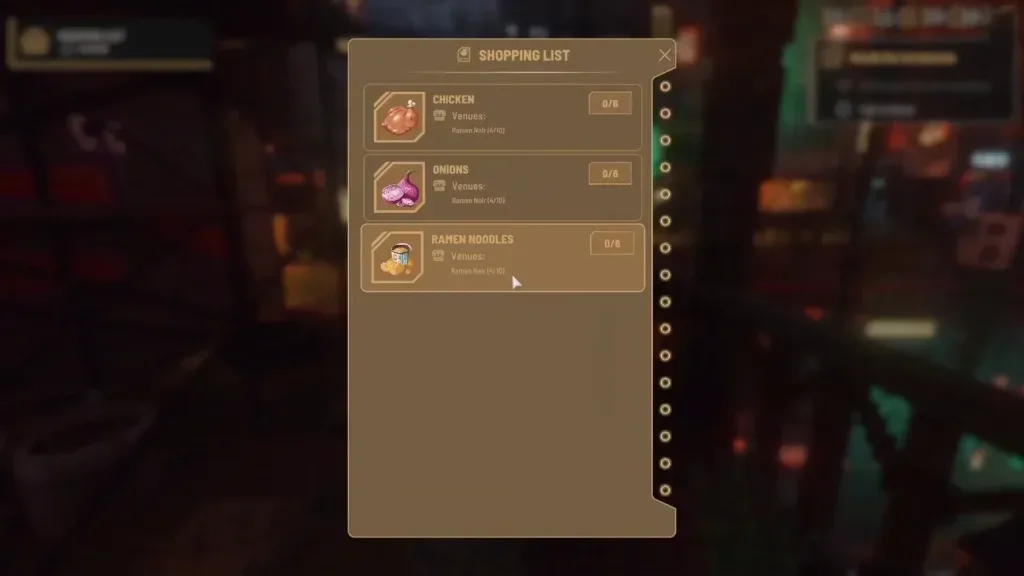
Follow a short pre-opening routine:
- Finalize the menu before buying supplies.
- Open the Shopping List and note only the displayed shortages.
- Compare the shortages with what you can obtain reliably that day.
- Buy or supply the missing ingredients without adding an unsupported safety quantity.
- Return to the venue inventory and confirm that required stock is stored correctly.
- Recheck the list after changing the menu, because adding or removing a dish changes demand.
Fishing can supply restaurant ingredients, and greenhouse produce can be used in your businesses or sold. These systems can support a focused menu, but they should not force the menu in the opposite direction. Choose dishes that suit the venue first, then use fishing or greenhouse production to strengthen that supply plan. Avoid adding a weak dish merely because you happen to own one of its ingredients.
Control freshness and storage risk
Ingredients need storage, and some require refrigeration. Restaurants provide some storage space, while cabinets, shelves, fridges, and freezers can extend it. Before broadening a menu, confirm that the venue can store the additional ingredient types appropriately.
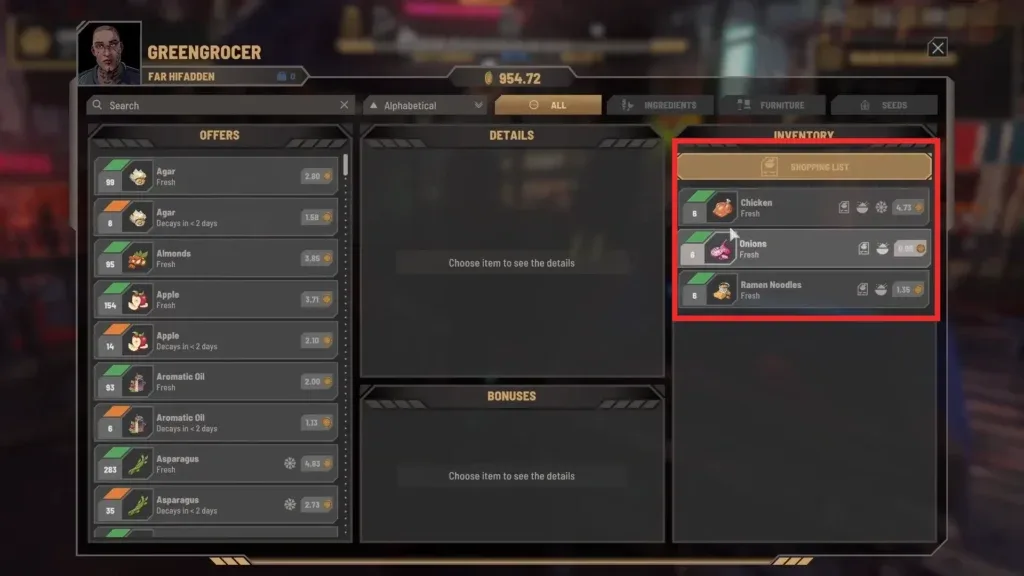
More inventory is not automatically safer. Excess stock can tie up cash, and food can spoil. The launch build may also use newer stock before older stock, allowing older ingredients to remain until they spoil. That makes large speculative purchases risky even when the ingredient is used by an active dish.
Reduce that risk by keeping the menu narrow enough to monitor, checking important ingredient stocks yourself, and avoiding large purchases without a clear need. When a particular ingredient repeatedly spoils, identify which menu item requires it. If that dish is the only consumer and does not provide strong demand coverage, removing the dish may be better than continuing to replace wasted stock.
Review the menu after each operating day
The best menu is found through controlled adjustments. The venue monitor tracks finances over different periods and can show menu performance information such as a best seller once enough activity exists. Reviews and customer satisfaction add context, while staff assignments and happiness help explain whether poor service is a menu problem or an operating problem.
At the end of a day, review:
- total gains, costs, and balance;
- which menu item sold best, when the venue has enough activity to show one;
- whether any dish became unavailable because of ingredients or equipment;
- which ingredients remained in excess or approached spoilage;
- whether staff coverage was adequate for cooking, waiting, and cleaning;
- whether the displayed price produced acceptable satisfaction;
- whether the Manager bought too much, bought the wrong stock, or failed to cover a shortage.
Change one major variable at a time. If you replace several dishes, alter prices, change staff schedules, and buy new equipment together, the next day’s result will not reveal which decision helped. A clean test is to remove one troublesome dish, run the business again, and compare stock stability and the balance.
Fix an unprofitable menu
When the restaurant is losing money, do not immediately add more recipes. Simplify the operation and locate the cost first.
- Remove any dish that cannot be prepared because its equipment is missing.
- Remove or postpone dishes whose ingredients are consistently unavailable.
- Identify ingredients used by only one menu item and check whether they are creating waste.
- Retain the dishes with the strongest preference fit and greatest ingredient overlap.
- Check wages and staff schedules so labor costs are not mistaken for a menu failure.
- Watch Manager spending rather than assuming automation is purchasing efficiently.
- Run the smaller menu for another day and compare the resulting balance.
If the venue stabilizes, add only one dish at a time. The next addition should either improve local preference coverage, reuse the existing supply chain, or make good use of equipment you already own. If it does none of those things, unlocking it is not a sufficient reason to serve it.